Even when it was completed, the firing would not be straightforward. It would require favourable weather conditions with the wind blowing in the right direction, and monitoring round the clock.
There was another vital component Derek hadn’t perhaps taken into consideration – sympathetic neighbours. Between 1957 and 1962 he achieved sixteen firings, with the fire brigade being called out on many occasions by locals startled by the ominous black smoke that rose above the town.
“Firing glaze. Fine.” (Weather)
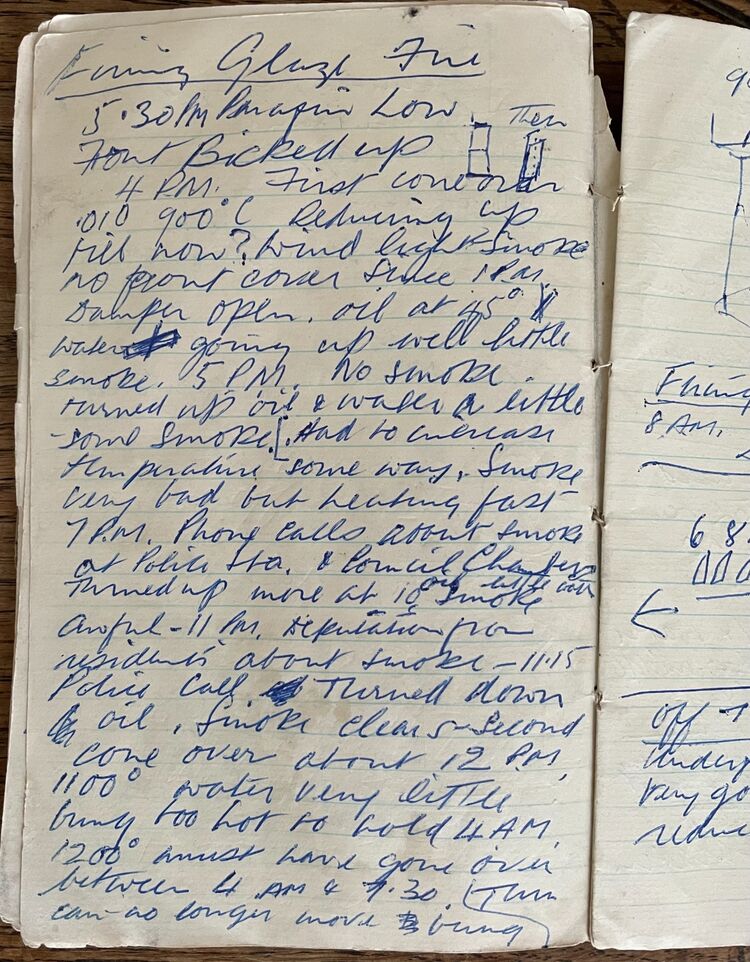
“5:30 PM paraffin low. Front bricked up 4 PM. (Small diagram) First cone over .010 900°C. Reducing up till now? Wind light. Smoke. No front cover since 1 PM. Damper open. Oil at 45°(angle), water (diagram here shows 30º angle). Going up well. Little smoke. 5 PM no smoke, turned up oil and water a little. Some smoke.
Had to increase temperatures someway. Smoke very bad but heating fast 7 PM. Phone calls about smoke at Police Station and Council Chambers. Turned up more at 10 oil smoke little but awful. 11 PM deputation from residents about smoke 11.15 police call. Turned down oil. Smoke clears - second cone over about 12 PM, 1100°. Water very little. Bung too hot to hold 4 AM, 1200° Must have gone over between 4 AM and 7.30. Can no longer move bung.
Turn off 7.30 . Under-fired 1200°. Very good reduction.
Sequence: paraffin, paraffin and oil, oil and paraffin, oil, oil and water.”
Between 1957 and 1962 Derek achieves a total of 16 firings with the kiln, the fire brigade being called out on numerous occasions by startled locals, seeing the ominous black smoke rising above the town.
Log book showing third firing, but first glaze firing with oil fired Kiln in Duff House garden.
Ref: 90